Friday, May 14, 2010

Healing by Helping Others


May 14, 2010 – blog update


Every time Andrea went back to the burn center for checkups, she tried to see and encourage newer patients. She felt this was her most important goal—the encouragement she could give them. She told me, “You never know but what you might be able to help a patient hang on, to give them courage, and to let them know there IS life after a burn, and to not give up. That’s the important thing to me now, the help I can give someone else.”
For instance, when she went back for another checkup on May 15, 2002 she talked with 2 men who’d been badly burned. One was burned over more than 80 percent of his body when the propane truck he was driving wrecked—and he had been in the ICU for 100 days. The other man was a painter. He was burned over 60 percent of his body, after paint fumes exploded. He was still in the ICU but was out of bed and in a wheel chair and ready to start walking again.
“Andy, the painter, asked a lot of questions. His hands were grafted, like mine, and he wanted to know every detail about therapy—how many hours and days a week it would take. I explained that it depends partly on the individual. Not everyone needs the same stretching exercises, and some patients will do their home exercises while others don’t. It takes constant work. I told him how I had no mobility in one ankle and one hand when I left the burn center to come home, so he could see the improvement. A year ago I didn’t know if I’d ever be able to ride again. But in just over a year I’ve improved a lot farther than my doctors thought I would,” she said.
[Andrea has been riding quite a bit since her injuries, helping us move cattle. The accompanying photo was taken on one of those rides]
“You set little goals for yourself. I told them about Emmy coming to see me while I was still in the hospital. I was too weak to hold her, and I could hardly bear to have her sit on my lap because it hurt my legs so much. I told them that during my 3 weeks as an outpatient (before I got to come home) the thing I worked at most was to try to regain enough strength, in at least one arm, to be able to pick her up. When I got home, I was able to pick her up for a moment, with my left arm. I told them things like that. The biggest thing, since they both had hand problems, was to diligently work on their hand exercises,” explained Andrea.
Through all her trips to Salt Lake, she was also a great encouragement to families of burn patients, especially the mothers of two young men who had been severely burned when they fell into near-boiling water in one of the thermal pools in Yellowstone Park. They suffered 3rd degree burns on about 95 percent of their bodies, being totally immersed in the hot water except for their heads. They’d been brought to the ICU when Andrea was just starting her experience as an out-patient, while Lynn was taking her back to the burn center almost daily for wound care assessment.
Lynn said those mothers were frantic, just like we had been. “The shock of the accident, not knowing whether your child was going to live or die—they were desperate,” he told me on the phone. “Trying to help them was a help to Andrea and me. Our reaching out to them made us both stronger. She’d already been encouraging other burn victims in the ICU, but these 2 boys were suddenly there, with a lot more skin gone; they would have a longer road to travel. But the main difference at that point was that she was farther down the road and had gotten through some of the terrible challenges they still had to face. She was up walking around. This, in itself, gave those mothers hope—just to see Andrea and her stage of progress. She had survived. She’d walked out of the burn ICU. She’d gotten past critical. Their sons could, too.”
One of the nurses told me later that this was a great encouragement to those mothers—Andrea being able to tell them that “this is the hardest thing in your whole life, but you can do it!”
Lynn told me that this role of being the comforter, the inspirer, helped Andrea deal with her own injuries and pain. “It gave her an outlet and a purpose, and something positive to do. We both realized that this was what we had to do—to talk to those mothers and show them that someone had been through this, like them, and survived.”
This was the start of a new focus for all of us—for Andrea as a burn survivor, dedicating her efforts to helping others, and for us as parents, trying to encourage other parents. Burn survivors and their families inadvertently joint a unique group, a fraternity like no other. These ties become strong and deep. Whenever you meet someone who’s had a similar trauma, there’s an instant bond. All the other differences in our lives or personalities are insignificant; we share much more than we don’t. People we became close to in Salt Lake that summer, and the ones we continue to meet, are very dear to us. Though we come from different backgrounds and lead vastly different lives, we are like family, but with an empathy and understanding that families often do not have.
The social worker at the burn center told us later that the summer of 2000, when Andrea was there, was one of those special times when families bonded. There were so many severe burns there all at once, and those families bonded partly just because the length of stay for all of those patients was so long. We coped with our own struggles partly by helping the others who were struggling, too. When you become part of that kind of “family” you are always a part of it.
Another facet of our new purpose in trying to encourage other burn survivors and their families stemmed from our deep gratitude for Andrea’s survival. We felt so blessed, because we didn’t lose our daughter. In thanksgiving, we felt compelled to do something in return, and the natural outlet for this effort was to help the ones who, like us, had been suddenly plunged into a terrible unknown. We could gently encourage them, and show them the love and help that others had shown us. This is our way of “paying it forward”, in continual thankfulness for the help and love that sustained us when we didn’t have the strength to get through it on our own.


Some of our friends here at home who helped us in every way they could (including spending time in the ICU with Andrea when we couldn’t be there) were also part of the reason we endured. This kind of friendship is a true blessing. We owe a large debt of gratitude to Bob and Jane Minor [pictured here with Emily and baby Charlie a couple years after Andrea’s accident], who helped us get through that terrible summer.
The sharing of families in trauma is one of the best things we can do for one another, and it becomes a wonderful blessing. When Andrea suffered her burn accident we had very little knowledge or understanding about this kind of injury. We had nowhere to turn, and didn’t know what we’d have to face. So when someone comes along who’s been there, and is farther down the road, we gratefully grab their hands and follow. We met several people in the days and weeks after Andrea’s burn who made a huge difference in our ability to cope.
Then, being able to be there for someone else and to do the same thing for them, you feel really good about it. You realize you’ve passed through the valley of the shadow of death and have come out the other side. You can extend a hand to someone who is still struggling through the worst parts of the journey and you can tell them they will survive, they will endure.
The more that Lynn and Andrea and I interact with other burn survivors and their families, and learn about their trials, problems and accomplishments, the more we realize that every burn survivor is special. This kind of injury happens to all kinds of people, but it indelibly marks them with a unique kind of courage. They become special because they have survived, and they have endured the unendurable. These are very ordinary people who have been called to become extra-ordinary, overcoming incredible odds.
Even if their burn injuries are not immediately life threatening, the long painful recovery and the fortitude they must develop to withstand the painful rehabilitation is heroic. They must all dig deeper into themselves to find more strength than they ever thought they could possess. Andrea’s continuing journey, still dealing with the impairments and problems from an accident that happened nearly 10 years ago, is a celebration of the human spirit, of triumph over great odds. We continue to rejoice in her life.

Tuesday, May 4, 2010


April 30 blog update –

During the Fall of 2001 Andrea continued to push herself physically, trying to regain strength and motion in her grafted limbs. She’d been an avid hunter before her accident, harvesting deer and elk for her family’s meat supply. She wanted to go hunting again. She loved hiking in the mountains; she and her dad had always enjoyed going hunting together. From the time she was a child, Andrea could mimic the sound of an elk calf or cow. When riding range in the summer to check on our cows, she and her horse were able to get very close to the elk, and one time she was in the middle of a group of cows with young calves, several of which came right up to her horse, out of curiosity. If she was hunting elk in the fall, a traveling herd of elk would always stop and listen when they heard her making the high-pitched eeeep-eeeep of an elk calf. After her burn injuries, however, with throat damage from the fire and from the ventilator tube, she was no longer able to make this sound.

She was able to get out in the hills several times during hunting season in 2001. Hiking was good physical therapy, helping her body get back into shape, and gradually forcing more movement in her knees and ankles in spite of the damaged tendons. After several unsuccessful hunts, she eventually got her elk, and then she spent parts of 4 days here at the ranch, cutting and wrapping the meat, with only a little help. She didn’t have much endurance yet, and was totally exhausted each day after a few hours cutting meat, but she didn’t want much help because she wanted to prove to herself that she could still do it.

The hunting was a milestone for her in regaining some of her abilities. It meant a lot to her, and to all of us, to see her excited and happy. And as she processed the meat at our kitchen table, it was a joy to me, seeing her working again so confidently. Her physical strength and dexterity were slowing increasing. It gave her hope that she might eventually be able to again do some of the things she loved. She realized it wouldn’t be easy, and that she’d have to find ways to compensate for some of her handicaps, but she was determined that those handicaps will never hold her back.

She came out to the ranch several times the next spring, to see the cows and help in small ways. She had some “favorite” cows that always enjoyed seeing her, and on several occasions she took Emily out in the field with her to look at the cows. Em was learning to be quiet around the cows, so as not to alarm them, especially when they had young calves.

Lynn and I had been amused at Emily the year before, when she was staying with us for a few days that spring while her mama went to Salt Lake for a check-up. Em rode with us in the feed truck each day when we fed hay to the cows. She wanted to pet a calf, but some of the mama cows are very protective, and most of the calves are skittish. One calf, however, named Roddenia, was a bold and curious heifer that often came right up to me whenever I walked through the cows and calves to check on them. I always look at every calf, to make sure none of the calves are sick. I thought Emily might actually be able to pet Roddenia.


So she and I quietly got out of the feed truck after Lynn fed the cows. While they were all busy eating their hay and not worrying much about their calves, we walked toward Roddenia, where she was playing with some of her little friends. We stopped, a safe distance away, before the other calves might become alarmed and run off. I told Emily to just stand quietly and not make a sound. I said, “These calves don’t know you, and they might be afraid of you.”

Roddenia became curious about this little person standing beside me, and came over to see us better. Emily reached out her hand to the approaching calf, and whispered, “Don’t be afraid. I’m Emily Daine.” I smiled and tried not to laugh out loud. Em took me literally; the calf was afraid because she didn’t know Emily, and now that Em had properly introduced herself, the calf would not be afraid! Indeed, Roddenia came boldly forward and sniffed, then licked, the 3-year-old child’s outstretched hand!


Emily got to see the cows and calves several times the next spring when Andrea came out to the ranch, and watched from the sidelines as we branded and vaccinated the calves. Andrea was regaining strength and was able to help us with that project.


As summer progressed, Andrea was also able to ride a few times with me again, riding Breezy to help me move cattle. She was glad to have a chance to see her horses—especially Snickers, her good old cowhorse. Even though she never rode Snickers again, that old mare still holds a special place in her heart, with lots of good memories from all the days of riding range and chasing cows. They’d been a good team, and Snickers had earned a well-deserved retirement.

A lot of things changed, for all of us, with Andrea’s burn injuries (since she could no longer help us full time on the ranch) but we feel blessed to still have her with us. Our priorities changed, as we realized that many of the little things we thought were important before, or worried about, are no big deal in the big picture scheme of things. The important things in life are love, family, compassion, and thankfulness for the blessings we often take for granted.

Saturday, March 20, 2010

February 26, 2010 - More challenges

Continuing to bring our story up to the present—last month we took a brief look at our daughter’s recovery process during the first winter and spring after her burn accident. Expanding on that, it must be mentioned that her marriage fell apart. She and Jim were able to separate amicably, however, and she later married her friend Mark.


When Andrea went back to Salt Lake for one of her checkups at the burn center and Dr. Saffle learned that she was pregnant, he was elated. He said that the hormones of pregnancy would help her skin heal faster. She also realized she was lucky that her torso was not burned in the fire. Her abdomen and back had been donor sites, providing healthy skin for grafting of her arms and legs. The donor sites healed back to normal and thus the stretching ability of the skin over her abdomen was not impaired—whereas grafted areas can never be elastic. Pregnancy can be very difficult if grafting goes all the way around the abdomen, because the grafted skin cannot stretch enough.

She was still on a lot of medication so she discussed this with her doctor to see which medications would still be safe to take. She quit the pain medications that might be harmful to the baby. Still, it was a rough pregnancy. About a month before the baby was due, Andrea was starting to dilate and the baby’s heartbeat was too low and very erratic. Her doctor sent her on a life flight to a specialist in Missoula, Montana, where they were prepared to take the baby by Caesarean if necessary. After a thorough checkup and keeping her there overnight to monitor the baby’s heartbeat, the doctor in Missoula decided to let her come home. The baby’s heartbeat was low, but not low enough to be life-threatening. The doctor thought Andrea’s blood sugar problems (which stemmed from becoming diabetic while in the burn ICU receiving high calorie nourishment via stomach tube to supply enough nutrients and energy to keep her alive and enable her body to heal) might be causing the trouble. She would have to keep close track of her blood sugar levels and was also on insulin for the rest of her pregnancy.


The last few weeks were rough, and the baby came 2 weeks early, but seemed normal and healthy at 8 pounds, 2 ounces. Charlie Casey Hansen arrived safely on August 24, 2001, after causing all of us a lot of worry. Little Emily proudly held her new little brother, and when she talked to us on the phone the next morning she told me excitedly, “Grandma! My baby brother popped out last night!”


But by the time little Charlie was 2 days old he wasn’t eating well and was burping up his milk and a lot of stomach fluid. Andrea got worried and took him back to the hospital where the doctor did x-rays and thought there might be a blocked bowel or an intestinal infection—and started him on antibiotics just to be safe. The nurses were able to start an IV in a vein in his tiny little hand. He continued to get worse so the doctor sent Andrea and baby on a life flight to Primary Children’s Hospital in Salt Lake. Blood cultures showed he had an intestinal bacterium (a deadly bug that had shut down his intestines and that’s why he was burping up all his milk), so he was kept on IV antibiotics for a week. During that time Andrea pumped milk for him. She couldn’t breast feed him because the doctors needed to measure everything he ate.

She stayed at the hospital with Charlie for 8 days and spent a lot of time on her feet, hiking between the baby ICU and the cafeteria, and the two hospitals (going back to the burn center next door to see the people who had made such a difference in her life the year before). Constant walking made a big difference in progress toward regaining mobility in her knees and ankles (the tendons of which had been so damaged in the fire). Her stiff left knee could almost straighten completely.

Three-year-old Emily stayed with us at the ranch while her mama was in Salt Lake, and made herself right at home like she had the summer before. She enjoyed helping me do chores, and petting her “baby horse” that was now a yearling.
After Andrea and Charlie came home, the baby stayed healthy. Andrea came out to the ranch a few times that fall and one day she rode with me to check on our cows in the mountain pasture. Carolyn (our daughter-in-law) took care of Emily and baby Charlie. It was Andrea’s first ride since early June and she was glad to be back on a horse again. We had a good ride, though she bumped her leg on a tree as we were going through dense timber—and scraped some of the delicate grafted skin off the leg. With no feeling in the thin, fragile grafts, it’s easy to nick or scrape that skin. But in spite of these challenges, her grafts were healing and “maturing” and looking better by that fall.

Other problems were more worrisome, at times. She got pneumonia again in mid-October, but it wasn’t quite as serious as the pneumonia she’d had in late May. She didn’t have to go to the hospital this time—she just drove to town daily for the antibiotic injections. On one office visit the doctor took a biopsy of a mole that had suddenly appeared on the grafted skin of her ankle. The grafts on her lower legs came from skin on her back, where she’d once had a malignant mole. Over the past 8 years her grafted legs continued to develop moles that had to be removed.


Little Emily started pre-school that fall. Not quite 4 years old, she was too young for kindergarten, but in October she started going to pre-school 4 hours a day, 3 days a week. She was proud and excited to be going to “school”.

UPDATE – RECENT GRAFT REPAIR – When Andrea went back to the burn center in Salt Lake for contracture release surgery on her right arm and hand in December 2009 and again in January, the goal was to remove/release some the thickened and contracting skin that was pulling all the joints out of line. The second surgery in January involved cutting out a large hunk of scar tissue in her upper arm and replacing it with skin from her upper thigh. The new graft didn’t “take” very well, however, and the doctors were afraid they might have to redo it. Instead of turning pink and healthy within a few days, it stayed gray and lifeless. So they didn’t let her come home, but kept checking on it. Her body did not reject it, however, so they kept hoping it would eventually “take”. Finally, 2 weeks later, there were signs that it was alive and starting to heal.

We kept her kids here at the ranch until she was able to come home on January 28.
It was a busy time, getting them to the school bus (a 2-mile drive down our creek to the highway) in the morning, taking the youngest one in later to pre-school, going back to town to pick her up in early afternoon, meeting the school bus in late afternoon. We had fun, but it was really nice to have mommy back again!
By this writing (February 26, 2010), her surgical sites are continuing to heal, but she will need to wear a pressure glove on her hand and wrist and some kind of pressure garment on her upper arm to try to keep the skin smoother and less lumpy and ridged as it heals—in hopes of preventing thick contractures (like from the first grafts) that caused such pain and disability.

Wednesday, February 10, 2010

“The Journey Continues”


4th Installment January 4, 2010...

After spending 6 weeks in intensive care at the burn center and 3 weeks in out-patient therapy in Salt Lake, Andrea came home September 2, 2000 and we settled into a routine of helping her with daily wound care/scrub and bandage changes, until the raw areas healed. There’d been more than 30 raw spots to deal with when she got out of the hospital (areas that had not been grafted, because they were small enough that they would eventually “self heal” with skin growing in from around the edges), and these were filling in.
The grafted areas had to be protected from rubbing. The grafted skin was itchy and dry--having no oil glands, because only the top layers of normal skin are “harvested” for use in grafting. Andrea had to diligently apply a special lotion to the grafted skin and donor sites after every scrub, before bandaging. After bandaging, she did stretching exercises and spent time using her pulleys; Lynn hooked them to the closet door in the living room where she could sit on a chair and alternately pull each arm above her head. Little Em was fascinated by the pulleys and tried them out herself. She also liked to help Grandpa with mommy’s arm stretches that had to be done several times a day.


Andrea was soon driving herself into town for her daily physical therapy sessions. Aggressive physical therapy is necessary to keep the healing skin stretched, to avoid loss of motion. Grafted skin tends to shrink and pull together as it heals, and any “self healing” open spots tend to form scar tissue that thickens and contracts. Without forceful therapy to keep stretching it, contracting skin on both sides of a joint may pull the joint into an abnormal position or make it impossible for the joint to be extended.


Andrea was also supposed to wear her pressure garments 23 hours a day to smooth the grafted areas and keep them from healing with lumps, bumps and thick scar tissue. Pressure helps scar tissue heal in a softer, flatter form. Maturing of grafts and scars takes many months, sometimes as much as 2 years, and burn patients are supposed to wear pressure garments during this time. Due to the claustrophobic feeling they gave her, and the way they intensified itching of the grafts (which made it impossible for her to sleep), Andrea didn’t wear hers very long. Also, the rubbery material pulled at the raw areas on her elbows and behind her knees and kept them from healing. She wore the upper garment periodically for about 7 months but didn’t wear the lower garment on her legs very much because of the big raw areas behind her knees. She chose to have thicker scars rather than prolong the open wounds that might need further graft surgery to close them. She didn’t want any more surgery.


She went to a local doctor in mid-September with intense pain in her leg, and he removed a staple that was working out. Thousands of small staples had hold the newly grafted skin in place, and even though nurses at the burn center try to take them all out after the grafts “take”, they usually don’t find them all. After removing the painful one, the doctor here x-rayed her arms and legs, and discovered 24 more staples. He wanted to surgically remove them, and called the burn center to see how to do it. They told him to not take the staples out—they would work out on their own during the next several years. Unless they cause problems, it’s better to leave them alone than to open up the fragile grafted skin to take them out—with risk for infection. Some have worked out during the 9 ½ years since Andrea’s grafting, but there are still a few embedded under the grafts.
That first winter was difficult and painful, necessitating several trips back to Salt Lake for checkups and regrafting one of her elbows. Both elbows had broken open while she was still in the burn ICU and this one was not closing up on its own. Instead, the raw area was becoming larger and was almost down to the bone, so it had to be grafted. She was unable to use that arm for awhile; it had to be immobilized in a splint until the graft was healing and wouldn’t tear loose with movement. Her ankles were still open and raw, but Andrea hoped they would eventually heal without surgery.
It was a long, cold winter. Andrea had always helped us with calving, but that year she was not strong enough, nor healed enough to be out working with the cows and calves. She couldn’t handle cold weather and we didn’t want risk of injury to her fragile skin. By spring she was eager to get more of her life back. She helped our son and his wife brand and vaccinate their calves.


Another milestone occurred when she got back in a tractor again to harrow our hayfields, to break up manure piles where we’d fed the cows through winter, spreadint them around as fertilizer. Driving the tractor to pull the harrow around the fields was a job she’d always enjoyed and she wanted to do it again. Her endurance was limited so she did it in short stints—just a few hours at a time, for 4 days. Lynn wanted to do part of it, but she insisted on doing it all. She wanted to prove to herself that she could still do it, and it was a way to help build up her stamina. Emily went with her in the tractor.
In late April she got back on her horse (Breezy) again, 9 months after her burn accident. She went with me to check gates and fences on part of our range pasture before we turned our cattle out on summer range. I saddled Breezy, but Andrea was able to get on the horse by herself. We rode 2 hours the first day and 3 hours the second day (checking and fixing fence) and she was really tired, but happy to be able to do this again.
In early May she rode with our daughter-in-law Carolyn on a longer ride to shut gates between our range and the neighboring range. A few days later she helped me take cows and calves to our upper pasture 3 miles up the creek. The front of the herd started trotting up the road, eager to go to new pasture, before the last ones were out the gate. Andrea had to gallop Breezy up the road to get ahead of the leaders before they got to a neighbor’s open driveway. I said a quick prayer, hoping Breezy wouldn’t stumble or buck. That mare is often silly and sassy on her first rides in the spring after a winter vacation. Andrea is a good rider, but she wasn’t very strong yet. She did fine, however, and outran the cows without incident.
She had several more rides that spring, and helped me and Carolyn gather cattle on our upper pasture to turn them out on the range. After that gather, little Emily had a short ride around the meadow with her mom, riding double on Breezy. Em had come along with Grandpa Lynn in the pickup truck while we were moving the cows, and was eager to go for a ride, too. She’s always likes to ride, and has been doing it since before she was born.
NOTE: UPDATE ON ANDREA’S RECENT SURGERY – Fast forward to the present. Andrea’s first surgery (for contracture releases) at the burn center in Salt Lake December 15, 2009 went fairly well. She went back on December 29 to have the stitches removed. Dr. Saffle did two contracture releases on her right hand/arm—one on the little finger that was being pulled off to the side, and one on her upper arm where contracting scar tissue was pulling her shoulder and spine out of line. The shoulder was still tight, however, because there wasn’t time that day (due to a scheduling error) to do the most crucial release at the top of her shoulder. That area was causing her the most pain and impairment of motion. Dr. Saffle only had time to do 2 of the 4 areas that needed releases. A surgical release over the shoulder itself would require more extensive work and additional grafting--and much more lay-up without being able to use the arm.
Within a couple weeks Andrea realized that she needed the additional surgery, because the continued pull at the top of her shoulder would soon negate the releases that had been done. She went back to Salt Lake on January 14 and Dr. Morris (the surgeon who did all of her original grafting, the summer of 2000) did the extensive release at her shoulder and armpit, taking a large patch of skin from the top/front of her thigh for the graft. This was the only place on her body that still had enough “untouched” skin—that had not already been grafted or harvested for grafting.
As I write this (January 17), she is still in Salt Lake, recovering from this surgery that was done last Friday, and she is hoping to be able to come home later this week.

Saturday, December 5, 2009

First Steps on the Road to Recovery


After her burn injuries, the medical team at the burn center started Andrea’s physical therapy even before she was out of intensive care—moving her arms, legs, fingers, trying to regain range of motion. Physical therapy is one of the most painful aspects of the recovery process, to minimize future disability. The grafted skin tends to shrink, and any formation of scar tissue also contracts, hindering mobility. The limbs must be forced to move, regaining range of motion little by little—a very painful process.
After nearly 6 weeks in the burn center, Andrea was finally able to get up and starting to walk. She was having intensive physical therapy several times a day by the time Lynn and I took little Emily to Salt Lake to visit mommy. Em was fascinated by the therapy exercises, especially the pulleys that Andrea used for stretching her arms and regaining shoulder motion. Em tried those, herself. And when the therapist helped Andrea walk down the hall, Em helped—holding Andrea’s hand to steady her on the other side.
Not long after that, Andrea was discharged from the hospital as an outpatient, but had to stay several more weeks in Salt Lake before coming home. She and Lynn stayed at the home of my cousin Ned Moser. Their days were full, and exhausting; Lynn was her “nurse”, doing bandage changes and scrubs, taking her to physical therapy every day, and back to the burn center for assessment of wound healing.
During that time, Emily and I continued to “hold the fort” at home. She went outside with me to do chores, except the times I quietly sneaked out very early to do the morning feeding before she woke up. On days I needed to ride range and move cattle, Emily stayed with friends and neighbors. Our son Michael, and daughter-in-law Carolyn and I did the range riding, often with the help of their two children. Little Heather was 9 that summer, and Nick was 7—and they were already good riders. Carolyn, Heather, Nick and I made some long hard rides moving cattle when Michael was busy haying.
It took several days to find and gather all the cattle on the middle range pasture and move them to the high range. On the fourth day, Carolyn, the kids and I rode for 9 hours to find and gather some of the last groups of cattle. At one point Nick and Heather took a bunch of cows more than a mile around the mountain all by themselves while Carolyn and I went over another hill to gather some others. We were very proud of our two young cowboys.

We also fixed fences. There were several places where trees had blown down and smashed the fence flat. We spliced the broken wires and put branches and small logs in the worst holes to make a temporary “fence” until someone had time to pack a chain saw in there to cut the trees off the fence and fix it properly.
It was a hot, dry summer and several springs and water troughs quit working. We had to continually check water sources and make some repairs, and sometimes move the cattle to different areas where there was more water.
Often the whole valley was filled with smoke from all the forest fires in our area. The Clear Creek fire burned more than 200,000 acres that summer and was uncontrolled until rain and cool weather put it out that fall. Wind currents brought ashes that drifted down and covered everything. Some mornings you could actually feel the heat from the fire—brought on a hot wind—like standing next to a campfire.
Emily and I were counting the days until Andrea and Grandpa could come home. We made a calendar and put it low on the wall where Em could mark off each day. She didn’t understand why she couldn’t just mark them off all at once! As the Big Day (September 2) approached, she helped me clean house and put up “Welcome Home” banners that friends made. We cooked a big, fancy dinner to celebrate. A special blessing was rain, the night before Lynn and Andrea drove home from Salt Lake. It cleared all the smoke from the air and left everything smelling fresh and new.
When Em and I went running outside to greet Andrea and Grandpa, the first thing Andrea did after she painfully got out of the car was to pick up Emily and hug her. Her goal—all through the 3 weeks of physical therapy as an outpatient—was to be able to pick up her child when she got home. And she did, very briefly, with her strongest (left) arm. Her right arm was more severely damaged and not yet strong enough.
For the first few weeks at home, Andrea and Em stayed at our house so we could assist with her daily wound care/scrub and bandage changes, and Lynn drove her to town for physical therapy 6 days a week. There were still many challenges to face, including a later regrafting of the skin over one elbow, but being home was a huge step in the journey.
NOTE: Fast forward 9 years and 3 months, to the present. “Recovery” is a relative term, for serious burn injuries, and is never complete. Andrea is now facing additional surgery to cut and release several contractions on her right hand and arm. The grafted skin has been pulling her little finger off to the side and impairing the use of her hand. Contractions on her upper arm are pulling her shoulder and spine, pulling her back out of line. She knew she’d have to eventually have surgery to correct this situation but has been putting it off, dreading more graft surgery and not wanting to be laid up for the amount of time it takes for healing (with her arm immobilized for awhile). But now the impairments have reached the point that she has no choice and must have them resolved. Her surgery is scheduled for December 15 in the burn center in Salt Lake, and she’ll probably remain there for about 5 days after the surgery. Her kids will be staying here on the ranch with Grandma and Grandpa. Please keep Andrea in your prayers as she goes through this stage of her journey.

Saturday, November 14, 2009

Surviving the Aftermath

A person never knows what’s around the next corner, in this journey of life. It’s a good thing our family didn’t have a clue about what was about to happen to us in July of 2000—our daughter’s severe burn injury--or we wouldn’t have been able to face it.
During that spring and early summer we were doing typical ranch tasks, taking care of the cattle, branding the calves and giving them their vaccinations, then turning the cows and calves out for summer pasture in the mountains. One of my main summer jobs was riding daily to check on the cattle—making sure they were staying in the right areas, checking gates to make sure they were shut, checking the water troughs and fences. Daughter Andrea often rode with me. She and I were often putting miles on young horses that needed training and experience. If there were any problems out there, the two of us could handle it—moving cattle, fixing a section of fence the elk tore down, patching a water trough or cleaning out a spring box to get more water coming into a trough.

That spring Andrea also helped Lynn with some tractor work. She and her baby girl spent many hours riding in the tractor to harrow the fields. Little Emily enjoyed going along with mom in the cab of the big tractor, in her car seat. She had her bottle for snacks and if she got tired, the motion and noise of the tractor lulled her to sleep.
Andrea and I were riding range the day before the accident. Andrea was riding her mare Breezy, helping me find and round up 5 cows and their bull calves to bring home. We had a really nice ride in which I had a good visit with my daughter. It was a bit challenging to find and gather those 5 pairs and get them home from the mountains—because the cows didn’t want to come down from the range, but a very successful roundup thanks to our good horses.


Then the night of July 5 we were plunged into that dark abyss, when Andrea was burned. She began the biggest challenge of her young life—to stay alive. One of my biggest hurdles to face was all the “what ifs…” What would I do if she perished? My daughter was in many ways my best friend. Not only did I love her as a mother loves a daughter, but she was also good help and a true partner in our ranch work. She was my partner in working with the cattle and training young horses (and my whole life style would be devastatingly changed if she was no longer here). She was also a wonderful companion; we had such good times together while calving, working cattle, training horses.

That summer was a blur of despair and hope, with Lynn spending most of the time in the burn ICU with Andrea, and me staying home taking care of Em and trying to keep the ranch going. Emily, at 2 years old, couldn’t understand why mommy wasn’t here, or where she was. We tried to explain about mommy’s “owies” and bandages. We gave her a doll to bandage and put stickers on the doll. Em also put stickers all over herself, to be bandaged like mommy.

Em helped me do chores, trundling along with me while I fed the horses, and the bulls in the corral. She especially enjoyed going with me to feed the mare and foal, out in the pasture. While I fed the mare hay, Emily picked grass and weeds to stick through gate to “feed” the baby horse. The foal would always come up to the gate and dutifully nibble whatever Emily offered.

We had a lot of help and support from friends and neighbors that summer, and cards and letters from many people we didn’t’ even know—people who had heard about the accident. Some sent donations to help with Andrea’s medical expenses. Em quietly played in the livingroom or watched children’s programs on TV while I wrote thank you notes to answer every card, letter, and gift of help. We used a photo of Andrea and Emily on the thank you notes—a nice picture that had been taken just a month before the accident.

After several weeks, when Andrea was no longer in such critical condition, we were finally able to take Emily to Salt Lake for a visit--to see her mom in the burn center. This was a major turning point for little Em because she was able to see and hug Andrea and knew that her mommy still existed. It was easier for her after that—talking to mommy on the phone, hearing Andrea’s voice. Em and grandma managed to mark time a lot better and “hold the fort” at home until mommy could come back to us.

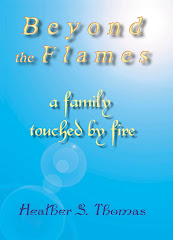
More details about those challenging weeks can be found in my book Beyond the Flames. In future blogs I’ll give more frequent updates on “life after the burn” and how things are going now with our family.

Monday, October 19, 2009

Introducing Myself – Why I wrote BEYOND THE FLAMES

As a child I always wanted a horse. My parents lived in a small rural Idaho town, and got a horse for me when I was 9 years old. The next year we acquired a cabin on several acres, and spent a couple summers there; then my parents began purchasing the neighboring ranch. From that point on, I grew up with horses and cattle--and for a long time these wonderful animals were the main focus of my life. I married a rancher in 1966 and we began raising our own herd of hardy, crossbred beef cattle that could thrive on rugged mountain pastures. We also raised a few horses, since taking care of our cattle required many hours on horseback.
The ranch was a wonderful place to raise children, as well. Our son and daughter grew up working with us—tagging along to ride range in summer or to feed cows in winter. They learned to ride on a gentle old mare named Khamette. She was the first horse I’d raised myself, when I was a young teenager. In her teen years she helped raise my children. Each of them in turn learned to ride her, at first being led from my own horse (when they were too small to control a horse by themselves) as we traveled many miles and hours checking cattle, fences and water troughs on the range, or moving and gathering cattle. Khamette could walk, trot or gallop right beside my horse, or drop back and follow if we had to traverse a narrow trail through the brush. The kid held the reins and gained confidence, but mom had the lead rope and the old mare worked in unison with my horse. As the kids got older, they each graduated to riding their own horses.
In winter they learned to drive the old jeep to help their daddy feed cows. While still very young, they stood on the seat to steer. Unable to reach the brakes, they could stop the outfit by turning off the key, if necessary. When they got big enough to reach the pedals, some of their starts and stops were abrupt; daddy had to learn to fall off the load of hay gracefully and try to land on his feet if his young driver popped the clutch!
Our son and daughter enjoyed working on the ranch and were excellent help as they grew up, learning to run the machinery (our son Michael started baling hay when he was 9 years old) and help with the cattle. Andrea became very good at helping me train the young horses we raised; we rode almost daily to check our cattle. “Sagebrush 101” was the best training ground for green horses.
Ranching is a wonderful way of life, but a difficult way to make a living. I helped make ends meet by writing. It was my “off farm job” that I could do at home at odd hours when I wasn’t being midwife to 170 cows during calving season or riding range in summer. I’d been writing stories and articles since high school, selling them to children’s magazines and then to horse and livestock publications. I wrote my first book (A Horse in Your Life; A Guide for the New Owner) when I was still in college. By the time our kids were growing up and ready to go to college, I’d sold more than 7000 articles and published 10 books.
Our son married Carolyn, whom he met at college. After a few years with good jobs in Boise, they both wanted to get back to the land (she was raised on a farm near Arco, Idaho), especially after their two children Heather and Nick arrived (born in 1991 and 1993); they didn’t want to raise their kids in the city. After leasing a couple different ranches in south central Idaho, they moved back to our place and we built them a home on part of our upper place. They use it as a base of operations for the several ranches they’re leasing nearby. We sold them several groups of cows over the years, to help them get started, and now they’re running 400 cows.
Our daughter married Jim, and they lived in a mobile home on our lower place, helping us with our cattle. Their first child, Emily, was born in 1998. Andrea and Jim had a small herd of cows of their own, here on the ranch, and worked part time for us with some other jobs on the side. My husband Lynn and I were delighted to have all our family close by, and were enjoying our grandkids. Then in the blink of an eye, our lives were forever changed.
Andrea suffered a terrible burn accident the night of July 5, 2000, while trying to help a friend control an out-of-control range fire—one of the first of many terrible fires that swept the West during that hot, dry summer. The wind changed and brought the fire over them while they were trying to make a fire line. Andrea ran through a wall of 20-foot high flames to get out of the fire, and then had to make it another quarter mile down the mountain. Only a series of miracles helped her survive,
including the incredible timing and teamwork of our local volunteer firemen, search and rescue unit and EMTs, to get Andrea and her friend to our little hospital 12 miles away, to be life-flighted to the Intermountain Burn Center at Salt Lake City, Utah.
She clung to life by sheer determination for many days, unwilling to give up because there was still so much she wanted to live for, and she didn’t want to leave 2 year old Emily without a mama. With severe burns over more than half her body, it was a tough fight, and many times her life hung by a thread. Family members took turns driving the 380 miles to Salt Lake, to have one of us always there at her bedside. We were as devastated emotionally as she was physically, and our lives went on “hold” as we tried to help her hang onto life.
This “detour” affected us profoundly—the ones who stayed with Andrea in the burn ICU to lend their strength for her to hang onto, and the ones who stayed home at the ranch to try to keep things going (thank God for neighbors who helped with the haying) and to take care of little Emily. Our experience that summer changed our lives, but ultimately blessed us. This was the beginning of a pilgrimage that taught us more about love, patience, caring and sharing, humility and compassion.
We eventually learned that God can create good from even the most terrible things imaginable. The community spirit here in our rural area was astounding, and the circle of support widened to include people we didn’t know—who helped us in countless ways and kept us in their prayers. It’s humbling to discover how much people care and are willing to help another human being, making us realize we are truly one big family. We continue to correspond (more than 9 years later) with people whose paths crossed ours that summer, many whom we’ve still never met. Some of the greatest encouragement came from other burn survivors and their families. This is a part of life we’d never known—with a depth of sharing and caring that’s both humbling and elating as we discovered a strong network of support. Anyone who goes through this kind of experience, either as a patient or a family member, will never be the same.
Eventually I realized I had to write a book about this, and share our story—in hopes it might be a way to encourage and inspire other people going through extreme trauma. This could be a way to “pay it forward” and help others, since there is no way we can ever totally thank the many people who helped us. So, a year after Andrea’s accident I finally got up the courage to start writing the book. It took another year to write it, and track down the many people (more than 100 of them) I wanted to interview, to capture their memories and details. It was amazing to me, how clearly some of them remembered those details, so long after the fact.
Then, it took another year to find a publisher, since the one who does my horse and cattle books was not interested in this topic. I sent queries and sample chapters to dozens of publishers. Some felt that a book like this would have a limited audience, while others felt they couldn’t do justice to it because it deserved a large audience than they could give it! It was a frustrating challenge, but one thing we’d learned from our epic journey through the burn center was to never give up. I am grateful to Billie Johnson (Oak Tree Press) for believing in this book and publishing it. It is my hope that our story—BEYOND THE FLAMES; A FAMILY TOUCHED BY FIRE-- will be of help to others who find themselves suddenly thrust into terrifying, life-changing circumstances.
Meanwhile, life has continued on, here at the ranch, though with some changes. In future blogs I’ll tell you more about our family and what we’ve been doing.